
North American society is getting sick. Every few days we hear reports of rising obesity rates, rising rates of cardiovascular disease, cancer, diabetes and stress. Walk into any office and you'll hear employees complaining about rising workloads or their employer taking advantage of them.
We all know that we need to eat better, exercise more and look after our health but the question is why so few people make it a priority.
Corporations have a legal responsibility to provide a safe workplace but also a social responsibility to provide a healthy workplace. If the only food available is chips and chocolate, I can guaranty that the employees will be eating it. If no opportunity is provided for employees to improve their health and fitness, chances
are they wont.
Employees feel they are working too hard, for too many hours and then spending too much time commuting. No wonder when they get home they don't think of making their fitness a priority. They are getting burned out and that's not good for them, their family, their employer, their community or society as a whole.
The cost of health care is also on the rise and our average age is rising so it's not going to get any better in the short term. Along with the rising cost of health care is the cost of insurance for employers.
The primary reason most employers do not provide any health programs to their employees is the perception that it will cost too much. Yes there may be an investment up front but money spent on corporate wellness pays dividends. Less sick time, more productive employees, lower health care premiums all easily pay for any up-front investment.
If employers want to get the most out of their employees they need to get creative with ways to encourage healthy lifestyles in their employees. Encourage your employees to take a walk at lunch by providing maps of walking routes for instance is an easy and cheep way to help your employees help themselves. Instead of offering donuts for meetings, offer something healthy.
Also employers should think beyond the easy little fixes as the benefits of a larger program would also be greater. Hit The Road...Running offers corporate running programs for beginners all the way to marathon runners. The programs run out of the companies office right after close of business and allows employees to take part before heading home. By building a corporate running team, employers can also get a lot of positive exposure at local races and events as well as around the neighbourhood where the business is located. Outfit your employees with t-shirts with your companies logo and you have an instant running billboard. Others will soon start to recognise that the employer values it's employees. The employees will have better communication and teamwork as well as a social aspect to their jobs which leads to better job satisfaction.
So how much will a program like this cost an employer? Very little; Most employers will just act as a host and allow the employees who are interested to pay for their own training. Just providing a meeting location will provide huge benefits to the employer. Other employers will opt to pay for the training as a benefit to employees but studies have found that when the employee pays for the training themselves, they tend to stick to it longer and get more out of it.
Want to add another major benefit? Try adding a charity component. Challenge your employees to run for your corporations favourite cause. The added commitment of fund raising often keeps people in the programs longer and gives them a sense of accomplishment. It also allows employers to benefit a good cause and meet their social responsibility.
Most people say that they would do more physical activity if it was more convenient so if your company can give people a program they want, when they want it the employees will jump at the opportunity and there's nothing for the employer to do but reap the benefits.
About The Author
Tony Denford is a certified personal trainer and owner or Hit the Road. He has been training primarily runners since 2002 and has worked with beginners all the way to Boston Qualifier Marathon runners.
Tony emphasizes balance and variety in his training methods and always tries to make sure his client’s fitness routines are fun as well as beneficial.
Visit www.hittheroadrunning.com for more details on Hit The Road’s programs and services.
Thursday, May 10, 2007

Wednesday, March 07, 2007
What you can learn from running

Each time you run, no matter how hard the workout is, try to look for the positive that is a result from the run. If you're running against the wind remember that it will make you stronger. If the run seemed harder than usual remember that it still counts and still made you fitter. Always look for the positive and whenever possible, write it down. Many of you probably keep a log of your runs and this is a great idea but remember to write down not only how far and how fast but things like how you felt and weather conditions. After a while you will start to notice that you go through cycles of good runs and not-so-good runs.
Lot of things can influence the feel of your run, for example diet, stress level, amount of sleep, weather or illness. Make sure you write down as much info as you can and if you notice you run easy after a good 8 hour sleep and suffer when you only get 6 hours then maybe you can learn something about how your body reacts to these influences and adjust your own behaviour to make your life a little easier.
Your running can be a good barometer of these influences but your whole life can be affected by them so take note and make changes as needed.
About The Author
Tony Denford is a certified personal trainer and owner or Hit the Road. He has been training primarily runners since 2002 and has worked with beginners all the way to Boston Qualifier Marathon runners.
Tony emphasizes balance and variety in his training methods and always tries to make sure his client’s fitness routines are fun as well as beneficial.
Visit www.hittheroadrunning.com for more details on Hit The Road’s programs and services.
Monday, February 05, 2007
Running in snow and ice
There are a few important things to remember when running in snowy and icy conditions. Here are a few simple rules to help you avoid slipping and falling.
About The Author
Tony Denford is a certified personal trainer and owner or Hit the Road. He has been training primarily runners since 2002 and has worked with beginners all the way to Boston Qualifier Marathon runners.
Tony emphasizes balance and variety in his training methods and always tries to make sure his client’s fitness routines are fun as well as beneficial.
Visit www.hittheroadrunning.com for more details on Hit The Road’s programs and services.
- Only do one of these things at a time: accelerating, decelerating and turning. Trying to turn while changing your speed can be disastrous and make you lose traction so slow down BEFORE you corner.
- Try to shorten your stride. This will help you recover if you do slip and also keeps your centre of balance over your planted foot. Another benefit is that taking faster steps can help to improve your VO2 Max and make you faster in the long run.
- Snow has more traction than ice so you're better to run in an inch of snow than not.
- If your neighbourhood tends not to clear it's sidewalk, find an area where the city maintains the walkways. Usually main non-residential roads are cleared by the city so at least the sidewalk is consistent.
- Go for a run in the country. There's usually a lot less traffic so it could be safe to run in the road as long as you're facing traffic and are prepared to dive into a snowbank if needed.
- If you live in an area with a lot of snow, try snowshoeing.
- Slow down. It's not worth doing your speed work in icy conditions. A broken leg will put you out for the whole season so use the winter to work on your base mileage, do some strength training or do your speed work indoors.
Most important is to use common sense but get out there and enjoy the cold. You'll be glad you did.
About The Author
Tony Denford is a certified personal trainer and owner or Hit the Road. He has been training primarily runners since 2002 and has worked with beginners all the way to Boston Qualifier Marathon runners.
Tony emphasizes balance and variety in his training methods and always tries to make sure his client’s fitness routines are fun as well as beneficial.
Visit www.hittheroadrunning.com for more details on Hit The Road’s programs and services.
Monday, January 29, 2007
Goal Setting
If you've gotten this far into the new year without setting some goals you are not alone. A vast majority of people do not set good goals for themselves and this trait is not helping them to realize their dreams.
I've written a lot before about goal setting but it's a good time to renew some of those ideas and if you're one of the many, start thinking about what's important to you.
Without a goal you cannot have a plan and without a plan you will not achieve great things. The first thing to do is think about what you want to achieve in the long run. Not this week or this month, maybe not even this year. Think about your ultimate goal. It could be to climb Everest or to do an ironman or run from coast to coast. Whatever it is, write it down and put it somewhere you will see it everyday.
Now you have your ultimate goal, start thinking about interim goals which will help you move in that direction. If your ultimate goal is to run a marathon, for example, set interim goals to run a 5K, 10K, half marathon etc.
Goals are good to have but there are several things you need to take into account when setting them. They must be achievable, specific and have a timeline. For example you could say that 'I want to be a runner' but this is not specific (what makes you a runner) and does not have a timeline (by when). A better goal would be 'I want to finish a 5K run within the next 3 months'. It's achievable, specific and has a timeline.
Now you have your interim goal, start out making the plan to achieve it. If you want to run 5K then you need to do some training so plan out how much time you have and can dedicate to achieving the goal. Be realistic with the plan and you can't fail. If your plan requires too much of your time or you think it's not achievable in the timeline you set, adjust the timeline.
If you are really a type 'A' personality you could be setting goals each and every day. Things you want to do that will move you towards your ultimate goal. Most people don't need to get into that much detail but having a plan for what you need to do in the next few days will be a big step to achieving your dreams.
About The Author
Tony Denford is a certified personal trainer and owner or Hit the Road. He has been training primarily runners since 2002 and has worked with beginners all the way to Boston Qualifier Marathon runners.
Tony emphasizes balance and variety in his training methods and always tries to make sure his client’s fitness routines are fun as well as beneficial.
Visit www.hittheroadrunning.com for more details on Hit The Road’s programs and services.
I've written a lot before about goal setting but it's a good time to renew some of those ideas and if you're one of the many, start thinking about what's important to you.
Without a goal you cannot have a plan and without a plan you will not achieve great things. The first thing to do is think about what you want to achieve in the long run. Not this week or this month, maybe not even this year. Think about your ultimate goal. It could be to climb Everest or to do an ironman or run from coast to coast. Whatever it is, write it down and put it somewhere you will see it everyday.
Now you have your ultimate goal, start thinking about interim goals which will help you move in that direction. If your ultimate goal is to run a marathon, for example, set interim goals to run a 5K, 10K, half marathon etc.
Goals are good to have but there are several things you need to take into account when setting them. They must be achievable, specific and have a timeline. For example you could say that 'I want to be a runner' but this is not specific (what makes you a runner) and does not have a timeline (by when). A better goal would be 'I want to finish a 5K run within the next 3 months'. It's achievable, specific and has a timeline.
Now you have your interim goal, start out making the plan to achieve it. If you want to run 5K then you need to do some training so plan out how much time you have and can dedicate to achieving the goal. Be realistic with the plan and you can't fail. If your plan requires too much of your time or you think it's not achievable in the timeline you set, adjust the timeline.
If you are really a type 'A' personality you could be setting goals each and every day. Things you want to do that will move you towards your ultimate goal. Most people don't need to get into that much detail but having a plan for what you need to do in the next few days will be a big step to achieving your dreams.
About The Author
Tony Denford is a certified personal trainer and owner or Hit the Road. He has been training primarily runners since 2002 and has worked with beginners all the way to Boston Qualifier Marathon runners.
Tony emphasizes balance and variety in his training methods and always tries to make sure his client’s fitness routines are fun as well as beneficial.
Visit www.hittheroadrunning.com for more details on Hit The Road’s programs and services.
Tuesday, January 02, 2007
New year's resolutions
Ah, it's that time of year again. The resolutionists come out of the woodwork only to disappear back again in about a month. Getting fitter and losing weight are perennials on the new years resolution top ten lists (usually in the top 3) but why do so many people come out in January only to be back to their old habits by February?
The answer is that they do not have a plan and that they have set unachievable goals.
The first thing to do is to look at your goal. A goal must have three components. It should be specific (measurable), achievable and have a timeframe. It's one thing to say "I want to lose some weight" but it's not likely to be successful. Try instead to add the three components for example "I want to lose 20 lbs by the end of April". Is this achievable? Probably, if you make a plan and stick to it. If however you wanted to lose 20 lbs by the end of January, I would suggest either changing the amount of weight or the timeframe. Setting goals that you are not willing to commit to will always fail so set a commitment that you are willing to live with.
Now that you have a good goal, it's time to set out your plan to achieve it. It won't happen all on it's own. Break your larger goal down into smaller chunks and write down what you need to do to make the milestones. Twenty pounds in four months can be easily broken down to five pounds a month. Five pounds a month is 1.25 pounds a week and we know that a pound equates to about 3200 calories. Now you just need to figure out how to get a deficit of 4000 calories a week that you are willing to live with. There are 2 ways of getting a calorie deficit; take less calories in and burn more calories. A combination of diet and exercise would be the most effective method.
Decide what dietary changes you are willing to make and what commitment to additional exercise you can realistically do and plan to do them. Don't make the mistake of over estimating the amount of exercise you will do which is one of the most common mistakes. If you currently do little or no exercise, it's not realistic to plan to be at the gym 5 times per week. Start out slowly and build up. Get used to exercising once a week. Once you're OK with that then increase it to two and so on.
The other common mistake is doing too much, too soon. This usually results in pain or injury and quitting. Give your body some time to adjust to the change before progressing to the next step. A realistic amount of change is 10% per week so if you are currently running 10K per week, increase it to 11K the first week. If you increase to 15K you will be sore and risk injury.
If this is too much for you, get help. If you really want to change, get the help of experts who can help you set a goal, make a plan and follow it. Hire a nutritionist or personal trainer but make sure they are qualified to be giving advise. There are a lot of people out there giving advise and if you are turning your hard earned cash over to them, ask what their qualifications are and make sure they are right for you. Even if you think you can do it yourself, you will be far more successful if you have someone coaching you through the process (Take a look at Hit The Road's Coaching Services) who will guide you through the process and give you someone to be answerable to.
Lastly, good luck. Don't become one of the 80% of resolutionists who are gone within a month. Set your goals, make a plan and achieve them.
About The Author
Tony Denford is a certified personal trainer and owner or Hit the Road. He has been training primarily runners since 2002 and has worked with beginners all the way to Boston Qualifier Marathon runners.
Tony emphasizes balance and variety in his training methods and always tries to make sure his client’s fitness routines are fun as well as beneficial.
Visit www.hittheroadrunning.com for more details on Hit The Road’s programs and services.
The answer is that they do not have a plan and that they have set unachievable goals.
The first thing to do is to look at your goal. A goal must have three components. It should be specific (measurable), achievable and have a timeframe. It's one thing to say "I want to lose some weight" but it's not likely to be successful. Try instead to add the three components for example "I want to lose 20 lbs by the end of April". Is this achievable? Probably, if you make a plan and stick to it. If however you wanted to lose 20 lbs by the end of January, I would suggest either changing the amount of weight or the timeframe. Setting goals that you are not willing to commit to will always fail so set a commitment that you are willing to live with.
Now that you have a good goal, it's time to set out your plan to achieve it. It won't happen all on it's own. Break your larger goal down into smaller chunks and write down what you need to do to make the milestones. Twenty pounds in four months can be easily broken down to five pounds a month. Five pounds a month is 1.25 pounds a week and we know that a pound equates to about 3200 calories. Now you just need to figure out how to get a deficit of 4000 calories a week that you are willing to live with. There are 2 ways of getting a calorie deficit; take less calories in and burn more calories. A combination of diet and exercise would be the most effective method.
Decide what dietary changes you are willing to make and what commitment to additional exercise you can realistically do and plan to do them. Don't make the mistake of over estimating the amount of exercise you will do which is one of the most common mistakes. If you currently do little or no exercise, it's not realistic to plan to be at the gym 5 times per week. Start out slowly and build up. Get used to exercising once a week. Once you're OK with that then increase it to two and so on.
The other common mistake is doing too much, too soon. This usually results in pain or injury and quitting. Give your body some time to adjust to the change before progressing to the next step. A realistic amount of change is 10% per week so if you are currently running 10K per week, increase it to 11K the first week. If you increase to 15K you will be sore and risk injury.
If this is too much for you, get help. If you really want to change, get the help of experts who can help you set a goal, make a plan and follow it. Hire a nutritionist or personal trainer but make sure they are qualified to be giving advise. There are a lot of people out there giving advise and if you are turning your hard earned cash over to them, ask what their qualifications are and make sure they are right for you. Even if you think you can do it yourself, you will be far more successful if you have someone coaching you through the process (Take a look at Hit The Road's Coaching Services) who will guide you through the process and give you someone to be answerable to.
Lastly, good luck. Don't become one of the 80% of resolutionists who are gone within a month. Set your goals, make a plan and achieve them.
About The Author
Tony Denford is a certified personal trainer and owner or Hit the Road. He has been training primarily runners since 2002 and has worked with beginners all the way to Boston Qualifier Marathon runners.
Tony emphasizes balance and variety in his training methods and always tries to make sure his client’s fitness routines are fun as well as beneficial.
Visit www.hittheroadrunning.com for more details on Hit The Road’s programs and services.
Friday, December 08, 2006
Don't let winter make you SAD

Don't let this cold weather get you down. There are many advantages to running through the winter.
Firstly, if you're running during the day you will dramatically reduce your chances of being affected by Seasonal Affective Disorder (SAD) otherwise known as the winter blahs. By getting more sunlight you will feel better which will also encourage you to eat better and exercise more. Inactivity is a double edged sword as the less active you become the easier it is to stay inactive and the harder it becomes to make healthy choices.
Secondly it's much easier to run in the cold than the hot from a cardiovascular point of view. The air is denser and there's less pollution so you have better oxygen delivery to the muscles allowing you to be much more effective at fatty acid oxidation which is the energy system commonly called the 'fat burning zone'.
By maintaining or lowering your body fat composition during the winter you are fighting back the body's natural response of storing more fat during the hibernation months.
Maintaining your base fitness during the winter also gives you a jump start on next years running season and you will not spent the spring and early summer getting back the fitness you lost.
As always, remember safety. Run a little slower if it's icy and take precautions against bad weather such as layering, covering exposed skin, heading out into the wind for the first half of your run and choosing routes that allow you to make a short cut home in case the weather starts to get to you.
I can assure you that running through the winter is not as bad as you think. There's only a few really bad days each year when you really shouldn't run but don't let them hold you back from being ready for next years bikini season.
About The Author
Tony Denford is a certified personal trainer and owner or Hit the Road. He has been training primarily runners since 2002 and has worked with beginners all the way to Boston Qualifier Marathon runners.
Tony emphasizes balance and variety in his training methods and always tries to make sure his client’s fitness routines are fun as well as beneficial.
Visit www.hittheroadrunning.com for more details on Hit The Road’s programs and services.
Thursday, November 02, 2006
Leg Strength and Running Efficiency

Most people think leg strength is the most important factor to your running performance but it actually only a small part to your running efficiency. The leg muscles used while running on a road are the quadriceps which pull your legs forward, the hamstrings which pull your legs back and the calfs which give you lift and allow you to push off.
Most runners have strong quads and calfs just from running and their hamstrings which are usually imbalanced to their quads are stronger than the general population too. So excessively working these primary running muscles will not bring extensive benefits to your speed or comfort while running.
It's important to think about what your legs are anchored to. It's not the road, it's your core. A strong core will allow you to push yourself forwards much more efficiently. It will decrease the amount of effort it takes to propel yourself as less energy is wasted as your core does not move in the opposing direction to your movement.
So what should runners concentrate on in the gym? Work your rectus abdominus (abs) and erector spinae (lower back) evenly. You want to be balanced front to back. Also work your obliques which will help to stop the twisting motion which slows a lot of runners by wasting energy. You can also try to balance the strength between your quads and hamstrings which will help you push forwards and reduce your chance of hamstring injury.
If you're at a level where your legs and core are strong you can further fine tune your efficiency by working on your shoulders, chest and upper back to allow your arms to help in the forward propulsion.
Not only will working your core make your running more efficient, it will improve your posture and prevent injury too.
About The Author
Tony Denford is a certified personal trainer and owner or Hit the Road. He has been training primarily runners since 2002 and has worked with beginners all the way to Boston Qualifier Marathon runners.
Tony emphasizes balance and variety in his training methods and always tries to make sure his client’s fitness routines are fun as well as beneficial.
Visit www.hittheroadrunning.com for more details on Hit The Road’s programs and services.
Wednesday, October 25, 2006
Run the winter, don't let it run you!
Being new to running, you may be wondering what it's like running through the winter months. There are people who run from spring to fall and then go into hibernation for the six month Canadian winter. I know this because I used to be one of them. In March I would lace up my running shoes for the first time and head out and be in horror to find out I could not run more than a few minutes straight. By the time September came around I would be able to run 5K 6 minutes faster and actually enjoy my runs but as soon as the first hint of chill was felt, I would retreat into my house and complain about the winter weather.
I hated winter then and although it's still not my favourite season, I've actually found a way to make it seem so much shorter. I signed up for a clinic and committed to run all the way through the darkest months. To my surprise, it wasn't as bad as I had imagined. With just a few thin layers of clothing, I was able to get outside, get some much needed exercise as well as sunlight. I would often be surprised by how much nicer the weather was outside than I thought it was before I headed out. I was also surprised to find that everyone else thought I was mad and tended not to bother me as often, especially on the really cold days.
Before I knew it the weather was starting to warm up and there was light at the end of the tunnel and by the time March came around I was running comfortably and 7 minutes faster than the year before.
Be consistent, commit to a goal race and enjoy your winter.
About The Author
Tony Denford is a certified personal trainer and owner or Hit the Road. He has been training primarily runners since 2002 and has worked with beginners all the way to Boston Qualifier Marathon runners.
Tony emphasizes balance and variety in his training methods and always tries to make sure his client’s fitness routines are fun as well as beneficial.
Visit www.hittheroadrunning.com for more details on Hit The Road’s programs and services.
I hated winter then and although it's still not my favourite season, I've actually found a way to make it seem so much shorter. I signed up for a clinic and committed to run all the way through the darkest months. To my surprise, it wasn't as bad as I had imagined. With just a few thin layers of clothing, I was able to get outside, get some much needed exercise as well as sunlight. I would often be surprised by how much nicer the weather was outside than I thought it was before I headed out. I was also surprised to find that everyone else thought I was mad and tended not to bother me as often, especially on the really cold days.
Before I knew it the weather was starting to warm up and there was light at the end of the tunnel and by the time March came around I was running comfortably and 7 minutes faster than the year before.
Be consistent, commit to a goal race and enjoy your winter.
About The Author
Tony Denford is a certified personal trainer and owner or Hit the Road. He has been training primarily runners since 2002 and has worked with beginners all the way to Boston Qualifier Marathon runners.
Tony emphasizes balance and variety in his training methods and always tries to make sure his client’s fitness routines are fun as well as beneficial.
Visit www.hittheroadrunning.com for more details on Hit The Road’s programs and services.
Tuesday, October 17, 2006
Winter Running
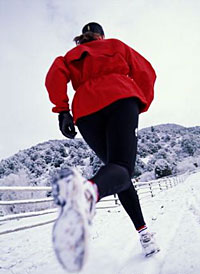
As the weather gets cooler, I tend to get a lot of questions about what to wear when running outside. Here's a few tips about what to wear as the weather cools.
The first thing I would invest in is a good light weight jacket. Look for ones made of moisture wicking material that will get your sweat out but also keep the weather out. One layer is usually fine and if it has a lining it may be too hot when it's just a little chilly outside.
Get a good pair of wind pants too. I find if I can keep the wind out, I'm much happier during my runs.
Apart from these two items just layer. You can wear two t-shirts under your jacket and you have the option to take one off if you're too warm. Again, look for wicking materials.
Once it starts to get colder you can get a hat and some gloves from the dollar store to keep your ears and fingers warm as these tend to be the places that feel the cold first. If the temperature dips below zero you should start to cover up exposed skin to keep it from freezing.
Always dress like it's 10 degrees warmer than it is. You'll only feel cold for the first 3-5 minutes and then you'll start to heat up. Also if it's windy, plan to run into the wind for the first half of your run. This way you'll be warm with the wind at your back on the way home and you won't go out too far not realizing just how cold it is outside.
Running through the winter is the best way to keep your fitness up and to help combat that depressed feeling most people get through the winter. It's nowhere near as bad as you imagine it to be.
About The Author
Tony Denford is a certified personal trainer and owner or Hit the Road. He has been training primarily runners since 2002 and has worked with beginners all the way to Boston Qualifier Marathon runners.
Tony emphasizes balance and variety in his training methods and always tries to make sure his client’s fitness routines are fun as well as beneficial.
Visit www.hittheroadrunning.com for more details on Hit The Road’s programs and services.
Tuesday, October 10, 2006
Shin Splints
Shin Splints are the pain new runners often feel down the front of their shins.
Firstly, they usually come on whenever you suddenly increase your workouts either in distance or speed. They are very typical with brand new runners but they can come at any time.
The first thing you should do is slow down or reduce your mileage. Typically once you're warmed up they tend not to hurt too much until after you've stopped again. Secondly you really need to ice your shins. Get some ice cubes in a Ziploc bag and hold it directly on the skin for 5 minutes and then remove for 5 minutes, repeat this as many times as you can.
The next step would be to make sure your running shoes have plenty of cushioning. If they are old or have a lot of miles on them think about getting a new pair and mention your shin splint problem to the sales person.
Outside of these 'quick fixes' the best thing to do is prevent them in the first place. Make sure you have an effective stretching routine for your Tibialis Anterior Muscle. Also you should work on strengthening the muscle through toe raise exercises.
Follow all these steps and the problem should be short lived.
Firstly, they usually come on whenever you suddenly increase your workouts either in distance or speed. They are very typical with brand new runners but they can come at any time.
The first thing you should do is slow down or reduce your mileage. Typically once you're warmed up they tend not to hurt too much until after you've stopped again. Secondly you really need to ice your shins. Get some ice cubes in a Ziploc bag and hold it directly on the skin for 5 minutes and then remove for 5 minutes, repeat this as many times as you can.
The next step would be to make sure your running shoes have plenty of cushioning. If they are old or have a lot of miles on them think about getting a new pair and mention your shin splint problem to the sales person.
Outside of these 'quick fixes' the best thing to do is prevent them in the first place. Make sure you have an effective stretching routine for your Tibialis Anterior Muscle. Also you should work on strengthening the muscle through toe raise exercises.
Follow all these steps and the problem should be short lived.
Wednesday, September 13, 2006
Goal Setting

Goal setting is probably the most important part of any fitness program. Without a goal there is no real incentive to do the work necessary to obtain optimal fitness. All goals should have three elements. They should be achievable, they should be specific and they should have a timeline.
Take a few minutes today to think about what your fitness goals are. Don't leave it until tomorrow as it won't get done any you will end up like a ship without a rudder. Think about what you would like to achieve and when you'd like to achieve it. Once you've done this ask yourself if it is specific enough. It's not good enough to say 'run faster' or 'lose weight'. You want to be specific like 'I want to knock 2 minutes off my best 5K time' or 'I want to lose 5 pounds'.
Now that you have a specific goal, with a specific timeline you can start to plan the things you need to do to get you there. If your goal is to run a faster time, you could plan some speed workouts. If your goal is to lose 5 pounds you could plan to cut out the ice cream cake or do some additional cardio work or both. If the timeline you have in mind is unrealistic, adjust it so that it can be achieved. You cannot lose 30 pounds in 10 days but you may be able to do it within six months.
Once you have a goal and a plan to achieve it you can start to work towards it but you need to also make a commitment to getting it done. If you have setbacks along the way you can always adjust your goals but if you don't have a goal in the first place, you are far less likely to achieve something great!
With runners I often suggest signing up for races early so that you commit to continuing your training. Without a goal race, it's easy to miss a workout or two and once you do that it becomes a slippery slope and becomes harder to get back into it. Even if you have missed some workouts it still better to work towards a goal than to give up.
Challenge yourself today to set a goal race. If you want some suggestions you could check out http://hittheroadrunning.com/ as we often post upcoming local races.
Sunday, July 23, 2006
Tapering
For a printable version of this article, click here.
The importance of tapering for an endurance event cannot be over emphasized. Endurance events require a lot of mileage training and that training takes a toll on your body. In order to perform at your best in your goal event, it is important to time your taper so that you have the benefits of your built up fitness and sufficient rest so your body can handle the stress you are about to put it through.
Incorrect taper along with overtraining is the best way to ruin your race day. It can lead to injury, fatigue and lowered performance on race day.
Rest is a key component of your training for one key reason; if the training alone made you stronger, you would run faster at the end of the event than at the beginning. Your body actually adapts and repairs during rest so rest could be argued as more important than volume of training.
The goal of tapering.
We taper for two primary functions; to ensure our muscles are rested and fueled and to reduce the amount of fatigue due to lactic acid build-up. By allowing your muscle to repair themselves and reducing their fatigue, you can enter the race with the knowledge that your body will last longer before hitting the wall.
So when and how should you taper?
Depending on the length of the event, your taper should change. For a marathon for example you should spend a full 3 weeks tapering in order to let your muscles rest and repair and be ready for the race. For a half marathon you should taper for 2 weeks and for a 10K, one week should be sufficient.
The act of tapering require you to significantly reduce your mileage but increase the intensity of your runs. This gives your body more time for rest and repair but continues to increase or maintain your fitness level. This is an excellent time for some speed training where you can increase the number of mitochondria and your anaerobic threshold but be careful not to injure yourself at this late stage of training. Using a heart rate monitor to assist you in maintaining a suitable intensity is a much safer way of training than trying to run repeats at a particular pace which does not take into account factors like weather, inclines, your health or stress levels.
What is happening physiologically?
Whenever you exercise you are putting demands on your body. Your body reacts to these demands by adaptation in the form of muscle growth so in order to get stronger, you must first stress the muscle and deplete its stores of muscle glycogen. Your body's energy systems all work together and depletion of glycogen is inevitable as well as the production of Lactic Acid. By resting and carb loading you can replace the used muscle glycogen and allow your body to metabolize excess lactic acid. This way you will be entering race day well fuelled and without fatigue.
The most efficient way to replace muscle glycogen is to eat carb rich foods soon after finishing exercise. Usually eating within 30 minutes of exercise is the recommended timeframe. This in effect 'loads' the muscle with fuel for the next bout of exercise. After this time period, when your metabolism has returned to normal, you body is much more efficient at converting the fuel into body fat.
Another by-product of exercise is lactic acid. Lactic acid is produced when your muscles do not have enough oxygen to produce a complete aerobic chemical reaction. The consequence of lactic acid build-up is that it causes muscle fatigue and eventually muscle failure. Ensuring you have plenty of rest time before your big race will reduce the amount of base lactic acid you have in your muscles and allow you to work for longer before fatigue sets in.
Guidelines for Tapering
The length of your taper depends on the length of your goal race. Reduce your weekly total distance by 1/3 each week.
As you decrease your mileage, increase the intensity with the exception of the last week.
Do nothing more than a few light jogs in the last week. You should not risk a last minute injury.
Drink lots of water. Lactic acid is very water-soluble so this is a good method to remove lactic acid.
Ice any little aches and pains to reduce swelling in the days leading up to your race.
Do not ignore nagging chronic injuries.
About The Author
Tony Denford is a certified personal trainer and owner or Hit the Road. He has been training primarily runners since 2002 and has worked with beginners all the way to Boston Qualifier Marathon runners.
Tony emphasizes balance and variety in his training methods and always tries to make sure his client’s fitness routines are fun as well as beneficial.
Visit www.hittheroadrunning.com for more details on Hit The Road’s programs and services.
The importance of tapering for an endurance event cannot be over emphasized. Endurance events require a lot of mileage training and that training takes a toll on your body. In order to perform at your best in your goal event, it is important to time your taper so that you have the benefits of your built up fitness and sufficient rest so your body can handle the stress you are about to put it through.
Incorrect taper along with overtraining is the best way to ruin your race day. It can lead to injury, fatigue and lowered performance on race day.
Rest is a key component of your training for one key reason; if the training alone made you stronger, you would run faster at the end of the event than at the beginning. Your body actually adapts and repairs during rest so rest could be argued as more important than volume of training.
The goal of tapering.
We taper for two primary functions; to ensure our muscles are rested and fueled and to reduce the amount of fatigue due to lactic acid build-up. By allowing your muscle to repair themselves and reducing their fatigue, you can enter the race with the knowledge that your body will last longer before hitting the wall.
So when and how should you taper?
Depending on the length of the event, your taper should change. For a marathon for example you should spend a full 3 weeks tapering in order to let your muscles rest and repair and be ready for the race. For a half marathon you should taper for 2 weeks and for a 10K, one week should be sufficient.
The act of tapering require you to significantly reduce your mileage but increase the intensity of your runs. This gives your body more time for rest and repair but continues to increase or maintain your fitness level. This is an excellent time for some speed training where you can increase the number of mitochondria and your anaerobic threshold but be careful not to injure yourself at this late stage of training. Using a heart rate monitor to assist you in maintaining a suitable intensity is a much safer way of training than trying to run repeats at a particular pace which does not take into account factors like weather, inclines, your health or stress levels.
What is happening physiologically?
Whenever you exercise you are putting demands on your body. Your body reacts to these demands by adaptation in the form of muscle growth so in order to get stronger, you must first stress the muscle and deplete its stores of muscle glycogen. Your body's energy systems all work together and depletion of glycogen is inevitable as well as the production of Lactic Acid. By resting and carb loading you can replace the used muscle glycogen and allow your body to metabolize excess lactic acid. This way you will be entering race day well fuelled and without fatigue.
The most efficient way to replace muscle glycogen is to eat carb rich foods soon after finishing exercise. Usually eating within 30 minutes of exercise is the recommended timeframe. This in effect 'loads' the muscle with fuel for the next bout of exercise. After this time period, when your metabolism has returned to normal, you body is much more efficient at converting the fuel into body fat.
Another by-product of exercise is lactic acid. Lactic acid is produced when your muscles do not have enough oxygen to produce a complete aerobic chemical reaction. The consequence of lactic acid build-up is that it causes muscle fatigue and eventually muscle failure. Ensuring you have plenty of rest time before your big race will reduce the amount of base lactic acid you have in your muscles and allow you to work for longer before fatigue sets in.
Guidelines for Tapering
The length of your taper depends on the length of your goal race. Reduce your weekly total distance by 1/3 each week.
As you decrease your mileage, increase the intensity with the exception of the last week.
Do nothing more than a few light jogs in the last week. You should not risk a last minute injury.
Drink lots of water. Lactic acid is very water-soluble so this is a good method to remove lactic acid.
Ice any little aches and pains to reduce swelling in the days leading up to your race.
Do not ignore nagging chronic injuries.
About The Author
Tony Denford is a certified personal trainer and owner or Hit the Road. He has been training primarily runners since 2002 and has worked with beginners all the way to Boston Qualifier Marathon runners.
Tony emphasizes balance and variety in his training methods and always tries to make sure his client’s fitness routines are fun as well as beneficial.
Visit www.hittheroadrunning.com for more details on Hit The Road’s programs and services.
Tuesday, May 30, 2006
Hot weather running
The heat can make it difficult to get all your training in but there are ways to make it a little more comfortable.
The two major issues with the heat are air quality and heat stroke. If you suffer from a respiratory issue you should either run very early in the morning before the low level ozone gets cooked by the sun, run on a treadmill or even consider not running on air quality days.
Heat stroke is also a serious concern and can be deadly. Here are some tips for keeping cool:
- Drink lots of water or sports drink that can replace some of the electrolytes you lose while sweating.
- Run when it's cooler outside either early in the morning or late at night.
- Try to pick a shady route and make mental notes of where there are water fountains or other places to get a drink.
- Make sure someone knows how long you will be out and where you are going.
- Wear light coloured materials and a hat.
- Don't forget the sunblock.
- You will also be more comfortable in technical fabrics that wick the moisture away from your body and help you keep cool.
- Slow down and take it easy, don't forget to cool down slowly at the end of the run.
- Know the signs of heat stroke and get help if you are not feeling well.
Just in case you're not sure, here are the symptoms:
- headache
- dizziness
- disorientation, agitation or confusion
- sluggishness or fatigue
- seizure
- hot, dry skin that is flushed but not sweaty
- a high body temperature
- loss of consciousness
- rapid heart beat
- hallucinations
So if you feel like you are drunk and it's 40°C and giant spiders are painting the buildings around you, it's probably time to ask for help!
The two major issues with the heat are air quality and heat stroke. If you suffer from a respiratory issue you should either run very early in the morning before the low level ozone gets cooked by the sun, run on a treadmill or even consider not running on air quality days.
Heat stroke is also a serious concern and can be deadly. Here are some tips for keeping cool:
- Drink lots of water or sports drink that can replace some of the electrolytes you lose while sweating.
- Run when it's cooler outside either early in the morning or late at night.
- Try to pick a shady route and make mental notes of where there are water fountains or other places to get a drink.
- Make sure someone knows how long you will be out and where you are going.
- Wear light coloured materials and a hat.
- Don't forget the sunblock.
- You will also be more comfortable in technical fabrics that wick the moisture away from your body and help you keep cool.
- Slow down and take it easy, don't forget to cool down slowly at the end of the run.
- Know the signs of heat stroke and get help if you are not feeling well.
Just in case you're not sure, here are the symptoms:
- headache
- dizziness
- disorientation, agitation or confusion
- sluggishness or fatigue
- seizure
- hot, dry skin that is flushed but not sweaty
- a high body temperature
- loss of consciousness
- rapid heart beat
- hallucinations
So if you feel like you are drunk and it's 40°C and giant spiders are painting the buildings around you, it's probably time to ask for help!
Monday, April 03, 2006
Get off the couch - a negative look at inactivity
For a printable version of this article, click here.
I don't mean to panic you but have you ever given any thought to the consequences of your inactions? Not the consequences of your actions, you probably think about those quite often, I'm talking about thinking about what happens when you do nothing about something.
Most people believe they should 'live in the now' and I don't argue with that but what I'm talking about here is putting a little thought into what happens if you don't take care of yourself. You may be good today, fine tomorrow, even okay an a year from now but have you ever thought about how you want to be in 10 years, 20 years or even 50 years? Your own body is the single most important asset you have. Without it you would not have all those other things you hold so dear, so isn't it time to do a little preventative maintenance?
The inactive lifestyles of North Americans today means most adults will not be around in 50 years. For the first time in history our children's life expectancy at birth will soon be less than our own generation. There's a simple reason for this: - inactivity. Too much time sitting in front of the TV or the computer and not enough time spent on physical activity.
So back to those consequences. I've spent a lot of time thinking about the future and a lot of time thinking how I want it NOT to turn out. Fear is a great motivator so I use it to my own advantage.
Here's a list of some of the things I do NOT want to be when I'm older; unable to walk up a flight of stairs (or the CN tower), too large to sit comfortably on an airplane (I plan to travel), housebound (did I mention I plan to travel?), unable to enjoy the great outdoors (or indoors), unable to chase my kids or even grandchildren (I like the sound of kids laughter), unable to run away from danger (or towards safety), weak or in constant pain (I plan to enjoy later life).
Now, if any of these situations describe you or someone you know, don't take it personally. Not everyone is to blame for his or her own inability to have a great quality of life in older age, but most are. I always believe you should do what you can with what you have and also if you don't use it, you'll lose it.
I hear many excuses for not exercising. The most common one is 'I don't have time'. Of course you don't have time, you have a shorter life expectancy than those who exercise regularly. We have months or even years more time to do things and more importantly our quality of life in those later years is so much better that we can continue to live productive active lives for much longer. The odds of heart disease, stroke, obesity, diabetes, osteoporosis, and some cancers are all significantly reduced.
Another excuse I hear often is 'exercise hurts'. I don't know about you but I don't exercise to the point of pain. Whatever you choose to do, make sure you do it right. Being active and healthy does not have to be painful. Any activity helps, even a light walk. Your body was designed to move so move it.
The third big excuse is 'it's boring'. Again, you are doing something wrong if you find it boring. Think of something you'd like to do and do it. It could be a walk in the park, cycling, rock climbing, playing a team sport, running a marathon, whatever, just do something. Once you know what you like to do, find some people to do it with. Increase your social circle with like-minded people. Before you know it you'll have new friends and a more active lifestyle, two things that will dramatically improve your quality of life. Everyone is different so find something that appeals to you.
One of the things on the list was to not be in pain. I run and I often have non-runners telling me how I am going to ruin my knees and won't be able to walk when I'm old. Actually, with a little care, I will have stronger legs and more mobility in later life, especially if I keep up my active lifestyle, than those who are inactive. The 'little care' I'm talking about is making sure small injuries do not become chronic and doing a little preventative maintenance like stretching and improving my range of motion or maybe even getting the occasional massage. Even making sure my running mechanics are correct can help. The point is here to not just blindly work out until you injure yourself, get some professional help and advice and you'll be able to enjoy the activity for years to come.
One thing that even most active people neglect is their flexibility. Being flexible and having good range of motion is also very important. Whenever I see someone straining to get up out of a chair or hunched over and shuffling along the street I think about the fact I need to spend some more time on my flexibility. The inability to move your body freely will severely hinder the quality of life as you get older, so spend some time to stretch. While you're at it clear you mind and relax. Not only will you help your body but also reduce your stress levels and help your mind.
Being active does not have to be an obsession but it does deserve some thought. Think about the benefits of doing it and the consequences of not and then make a conscious decision. Write down some of those reasons and keep it somewhere. If you find yourself falling off the fitness bandwagon, read your list to remind yourself why you started in the first place.
Someone once said 'Live forever or die trying'. I like that mantra. I'm hoping you'll be around in 50 years to see this guy in his mid-eighties chasing a bunch of grandkids around in some far away exotic place. If you do, ask him if his name is Tony.
About The Author
Tony Denford is a personal trainer and owner or Hit the Road. He has been training primarily runners since 2002 and has worked with beginners all the way to Boston Qualifier Marathon runners.
Tony emphasizes balance and variety in his training methods and always tries to make sure his client’s fitness routines are fun as well as beneficial.
Visit www.hittheroadrunning.com for more details on Hit The Road’s programs and services.
I don't mean to panic you but have you ever given any thought to the consequences of your inactions? Not the consequences of your actions, you probably think about those quite often, I'm talking about thinking about what happens when you do nothing about something.
Most people believe they should 'live in the now' and I don't argue with that but what I'm talking about here is putting a little thought into what happens if you don't take care of yourself. You may be good today, fine tomorrow, even okay an a year from now but have you ever thought about how you want to be in 10 years, 20 years or even 50 years? Your own body is the single most important asset you have. Without it you would not have all those other things you hold so dear, so isn't it time to do a little preventative maintenance?
The inactive lifestyles of North Americans today means most adults will not be around in 50 years. For the first time in history our children's life expectancy at birth will soon be less than our own generation. There's a simple reason for this: - inactivity. Too much time sitting in front of the TV or the computer and not enough time spent on physical activity.
So back to those consequences. I've spent a lot of time thinking about the future and a lot of time thinking how I want it NOT to turn out. Fear is a great motivator so I use it to my own advantage.
Here's a list of some of the things I do NOT want to be when I'm older; unable to walk up a flight of stairs (or the CN tower), too large to sit comfortably on an airplane (I plan to travel), housebound (did I mention I plan to travel?), unable to enjoy the great outdoors (or indoors), unable to chase my kids or even grandchildren (I like the sound of kids laughter), unable to run away from danger (or towards safety), weak or in constant pain (I plan to enjoy later life).
Now, if any of these situations describe you or someone you know, don't take it personally. Not everyone is to blame for his or her own inability to have a great quality of life in older age, but most are. I always believe you should do what you can with what you have and also if you don't use it, you'll lose it.
I hear many excuses for not exercising. The most common one is 'I don't have time'. Of course you don't have time, you have a shorter life expectancy than those who exercise regularly. We have months or even years more time to do things and more importantly our quality of life in those later years is so much better that we can continue to live productive active lives for much longer. The odds of heart disease, stroke, obesity, diabetes, osteoporosis, and some cancers are all significantly reduced.
Another excuse I hear often is 'exercise hurts'. I don't know about you but I don't exercise to the point of pain. Whatever you choose to do, make sure you do it right. Being active and healthy does not have to be painful. Any activity helps, even a light walk. Your body was designed to move so move it.
The third big excuse is 'it's boring'. Again, you are doing something wrong if you find it boring. Think of something you'd like to do and do it. It could be a walk in the park, cycling, rock climbing, playing a team sport, running a marathon, whatever, just do something. Once you know what you like to do, find some people to do it with. Increase your social circle with like-minded people. Before you know it you'll have new friends and a more active lifestyle, two things that will dramatically improve your quality of life. Everyone is different so find something that appeals to you.
One of the things on the list was to not be in pain. I run and I often have non-runners telling me how I am going to ruin my knees and won't be able to walk when I'm old. Actually, with a little care, I will have stronger legs and more mobility in later life, especially if I keep up my active lifestyle, than those who are inactive. The 'little care' I'm talking about is making sure small injuries do not become chronic and doing a little preventative maintenance like stretching and improving my range of motion or maybe even getting the occasional massage. Even making sure my running mechanics are correct can help. The point is here to not just blindly work out until you injure yourself, get some professional help and advice and you'll be able to enjoy the activity for years to come.
One thing that even most active people neglect is their flexibility. Being flexible and having good range of motion is also very important. Whenever I see someone straining to get up out of a chair or hunched over and shuffling along the street I think about the fact I need to spend some more time on my flexibility. The inability to move your body freely will severely hinder the quality of life as you get older, so spend some time to stretch. While you're at it clear you mind and relax. Not only will you help your body but also reduce your stress levels and help your mind.
Being active does not have to be an obsession but it does deserve some thought. Think about the benefits of doing it and the consequences of not and then make a conscious decision. Write down some of those reasons and keep it somewhere. If you find yourself falling off the fitness bandwagon, read your list to remind yourself why you started in the first place.
Someone once said 'Live forever or die trying'. I like that mantra. I'm hoping you'll be around in 50 years to see this guy in his mid-eighties chasing a bunch of grandkids around in some far away exotic place. If you do, ask him if his name is Tony.
About The Author
Tony Denford is a personal trainer and owner or Hit the Road. He has been training primarily runners since 2002 and has worked with beginners all the way to Boston Qualifier Marathon runners.
Tony emphasizes balance and variety in his training methods and always tries to make sure his client’s fitness routines are fun as well as beneficial.
Visit www.hittheroadrunning.com for more details on Hit The Road’s programs and services.
Tuesday, March 21, 2006
Balance
For a printable version of this article, click here.
There are 3 types of balance that will affect your performance as an athlete;
Physical Balance
Muscle Balance
Life Balance
In order to reach your peak performance all of these must meet equilibrium.
Physical Balance
This is the ability to control your body's movement through space. Staying upright is just part of the equation. To train physical balance you must train your nervous system. Your nervous system can be trained in the same way your muscular system can by using the SAID principal. SAID stands for Specific Adaptation to Imposed Demands, which means that your body will adapt to whatever demands you put on it.
Therefore to train your balance you must make demands on it. One-legged postures, Balance balls etc are an excellent way to do this. After a while your balance will become second nature and as a result your brain will be better equipped to maintain your balance through everyday activities. This will also equate to better performance while running as your responses become faster.
Muscle Balance.
Muscle balance is usually the thing most people are concerned about as it can cause injury and pain.
Every movement your body does is due to a muscle contracting and pulling on a bone that is used as a lever. For each movement there is an opposing movement. For example you can bend your knee or straighten your knee. The opposing movements are caused by opposing muscle groups. For example the knee is bent by the hamstrings and straightened by the quadriceps. These opposing muscles are referred to as the agonist and antagonist.
The opposing muscle groups must be in balance to aid in the fluid motion of the body and prevent injury. If one muscle is much stronger than the other or too tight from a lack of stretching it can cause a joint misalignment that could lead to pain or injury.
The most common cause of back pain is an imbalance between the abdominal and erector spinae muscles. Runners Knee is an imbalance between the quads and hamstrings. Shin splints are an imbalance between the calf and tibialis anterior muscles. Strengthening the opposing muscle as well as stretching can avoid most injuries.
Life Balance
Nothing will be as unfulfilling as an imbalance in your life. The wellness triangle has three sides representing the mind, body and spirit. An imbalance between these three components of wellness will result in poor performance in many aspects of your life.
By concentrating solely on one of these components you will neglect the others so it is important to balance all three. You must train your body and mind and feed your spirit to live a balanced life. Your spirit is not necessarily religion but you should aim to feel good about how you live your life. Spend some time for yourself or enjoy your family or friends. Without this important component you will feel burned out and will not perform at your best.
There are 3 types of balance that will affect your performance as an athlete;
Physical Balance
Muscle Balance
Life Balance
In order to reach your peak performance all of these must meet equilibrium.
Physical Balance
This is the ability to control your body's movement through space. Staying upright is just part of the equation. To train physical balance you must train your nervous system. Your nervous system can be trained in the same way your muscular system can by using the SAID principal. SAID stands for Specific Adaptation to Imposed Demands, which means that your body will adapt to whatever demands you put on it.
Therefore to train your balance you must make demands on it. One-legged postures, Balance balls etc are an excellent way to do this. After a while your balance will become second nature and as a result your brain will be better equipped to maintain your balance through everyday activities. This will also equate to better performance while running as your responses become faster.
Muscle Balance.
Muscle balance is usually the thing most people are concerned about as it can cause injury and pain.
Every movement your body does is due to a muscle contracting and pulling on a bone that is used as a lever. For each movement there is an opposing movement. For example you can bend your knee or straighten your knee. The opposing movements are caused by opposing muscle groups. For example the knee is bent by the hamstrings and straightened by the quadriceps. These opposing muscles are referred to as the agonist and antagonist.
The opposing muscle groups must be in balance to aid in the fluid motion of the body and prevent injury. If one muscle is much stronger than the other or too tight from a lack of stretching it can cause a joint misalignment that could lead to pain or injury.
The most common cause of back pain is an imbalance between the abdominal and erector spinae muscles. Runners Knee is an imbalance between the quads and hamstrings. Shin splints are an imbalance between the calf and tibialis anterior muscles. Strengthening the opposing muscle as well as stretching can avoid most injuries.
Life Balance
Nothing will be as unfulfilling as an imbalance in your life. The wellness triangle has three sides representing the mind, body and spirit. An imbalance between these three components of wellness will result in poor performance in many aspects of your life.
By concentrating solely on one of these components you will neglect the others so it is important to balance all three. You must train your body and mind and feed your spirit to live a balanced life. Your spirit is not necessarily religion but you should aim to feel good about how you live your life. Spend some time for yourself or enjoy your family or friends. Without this important component you will feel burned out and will not perform at your best.
Wednesday, March 08, 2006
Leg Strength for Runners
For a printable version of this article, click here.
Leg strength is obviously very important to runners. Your legs are the main motion generating part of your body that you use to propel yourself forwards. Having strong legs will help prevent injury, make everyday activities easier, delay fatigue when you run and make you faster when you get to the hills!
When we talk about leg movement in running we are really three major joints in motion.
- The first is your hip joint. To provide forward motion you must flex your hip and then extend it backwards for the working phase of the motion.
- The second is the knee joint. The working phase is when you flex (or bend) the knee to provide forward motion.
- The third is the ankle joint. The working phase for running is what is called planter flexion (when you point your toes downward). This provides some additional forward motion but also vertical motion.
Of course there are other articulations such as the tarsal and metatarsals in the feet as well as some rotation motions but we are focusing on the primary movements which runners should be concerned about.
Now we know the three major movements involved in the legs producing a running motion, we need to look at which muscle groups are used to produce the movement of each. In kinesiology, we study the origin and insertion of the muscles (which bones they are joined to) and their impact on the movement of a joint. Each movement has an opposite movement so we need to look at the muscles in pairs to understand how to strengthen them. If one of the muscles in any pair is much stronger than the other or much tighter than the other, it will cause imbalance and alignment issues that will eventually lead to injury.
So back to the hip joint. The two major muscle groups for running associated with the hip are the Hip Flexors that provide forward motion of the upper leg and the Glutes that provide the rearward motion of the upper leg. The working phase is when you are pulling your upper leg rearward so the muscle used to do this are the Glutes. If you've ever looked at the physique of a sprinter, it's hard to miss the size of their Glutes. This is because the primarily use the fast twitch fibers of the muscles for explosive movements and fast twitch fibers increase in size when trained. The Glutes are one of the strongest muscles in the body and are often out of balance with the hip flexors. Most runners should be doing some additional training for their hip flexors to prevent injury as well as stretching their Glutes to ensure good flexibility and range of motion.
Some good hip flexor strengthening exercises are sit-ups, hanging leg raises, rubber bank kicks and lever hip flexion exercises. Look for exercises that bend you at the hip and bear weight as you flex the hip.
To strengthen your Glutes try lunges or squats. Ensure that when you do either of these exercises that the knee does not extend past the toes as this is a common mistake that often leads to injury. Any exercise that bears weight as you extend (straighten) the hip is good.
The knee joint is probably the most troublesome for runners. The main muscles that articulate the knee are the Quadriceps that extend the knee and straighten the leg and the hamstrings that flex the knee and bend the leg. These two muscles do a lot of the work for runners and often are neglected when it comes to stretching. The hamstring is typically the stronger of the two but to help strengthen the knee, it's worth some investment in strengthening both. One of the most common injuries in runners is Patellofemoral Syndrome (Runner's knee) which is typically caused by a shortening of the quad muscle which then misaligns the tendons below the kneecap causing swelling and pain. Pulling a hamstring can also sideline a runner. So as well as strengthening these muscles it's particularly important to regularly stretch them both.
Hamstring exercises such as leg curls are very effective. To stretch your hamstrings sit on the floor with your legs extended forwards and bend your upper body towards your feet. The best way to stretch your hamstrings is to have someone help you extend them while lying on your back.
Quadriceps exercises include leg extensions, lunges or squats. Exercised that bear weight as you straighten your lower leg are good. Quad stretches can be done with a standing knee bend pulling your heel up towards your buttocks.
Lastly the ankle. Runners typically have well developed calf muscles that run up the back of the lower leg and underdeveloped Tibialis Anterior muscles. The Tibialis Anterior is the muscle you feel when you have shin splints and is used to pull the foot upwards. Usually shin splints are a result of suddenly increasing the workload on them such as running faster or longer without giving them a chance to adapt. So make sure you stretch the calves and strengthen and stretch your shins.
Calf exercises include any exercise where you push your toes downward such as standing on your tip toes or Calf raises. Stretch your calf by having the toes up against a wall, knee straight and leaning towards the wall.
Tibialis Anterior exercises include toe raises where you have weight as you lift the toes in an upward motion or reverse calf raises. Stretches that point the toes down will help this muscle.
As always the whole picture is much more complicated than the simplified version I've presented here and there are all kinds of collateral muscles that will aid and strengthen your legs so it's important to do a variety of exercises and movements to have strong legs.
Leg strength is obviously very important to runners. Your legs are the main motion generating part of your body that you use to propel yourself forwards. Having strong legs will help prevent injury, make everyday activities easier, delay fatigue when you run and make you faster when you get to the hills!
When we talk about leg movement in running we are really three major joints in motion.
- The first is your hip joint. To provide forward motion you must flex your hip and then extend it backwards for the working phase of the motion.
- The second is the knee joint. The working phase is when you flex (or bend) the knee to provide forward motion.
- The third is the ankle joint. The working phase for running is what is called planter flexion (when you point your toes downward). This provides some additional forward motion but also vertical motion.
Of course there are other articulations such as the tarsal and metatarsals in the feet as well as some rotation motions but we are focusing on the primary movements which runners should be concerned about.
Now we know the three major movements involved in the legs producing a running motion, we need to look at which muscle groups are used to produce the movement of each. In kinesiology, we study the origin and insertion of the muscles (which bones they are joined to) and their impact on the movement of a joint. Each movement has an opposite movement so we need to look at the muscles in pairs to understand how to strengthen them. If one of the muscles in any pair is much stronger than the other or much tighter than the other, it will cause imbalance and alignment issues that will eventually lead to injury.
So back to the hip joint. The two major muscle groups for running associated with the hip are the Hip Flexors that provide forward motion of the upper leg and the Glutes that provide the rearward motion of the upper leg. The working phase is when you are pulling your upper leg rearward so the muscle used to do this are the Glutes. If you've ever looked at the physique of a sprinter, it's hard to miss the size of their Glutes. This is because the primarily use the fast twitch fibers of the muscles for explosive movements and fast twitch fibers increase in size when trained. The Glutes are one of the strongest muscles in the body and are often out of balance with the hip flexors. Most runners should be doing some additional training for their hip flexors to prevent injury as well as stretching their Glutes to ensure good flexibility and range of motion.
Some good hip flexor strengthening exercises are sit-ups, hanging leg raises, rubber bank kicks and lever hip flexion exercises. Look for exercises that bend you at the hip and bear weight as you flex the hip.
To strengthen your Glutes try lunges or squats. Ensure that when you do either of these exercises that the knee does not extend past the toes as this is a common mistake that often leads to injury. Any exercise that bears weight as you extend (straighten) the hip is good.
The knee joint is probably the most troublesome for runners. The main muscles that articulate the knee are the Quadriceps that extend the knee and straighten the leg and the hamstrings that flex the knee and bend the leg. These two muscles do a lot of the work for runners and often are neglected when it comes to stretching. The hamstring is typically the stronger of the two but to help strengthen the knee, it's worth some investment in strengthening both. One of the most common injuries in runners is Patellofemoral Syndrome (Runner's knee) which is typically caused by a shortening of the quad muscle which then misaligns the tendons below the kneecap causing swelling and pain. Pulling a hamstring can also sideline a runner. So as well as strengthening these muscles it's particularly important to regularly stretch them both.
Hamstring exercises such as leg curls are very effective. To stretch your hamstrings sit on the floor with your legs extended forwards and bend your upper body towards your feet. The best way to stretch your hamstrings is to have someone help you extend them while lying on your back.
Quadriceps exercises include leg extensions, lunges or squats. Exercised that bear weight as you straighten your lower leg are good. Quad stretches can be done with a standing knee bend pulling your heel up towards your buttocks.
Lastly the ankle. Runners typically have well developed calf muscles that run up the back of the lower leg and underdeveloped Tibialis Anterior muscles. The Tibialis Anterior is the muscle you feel when you have shin splints and is used to pull the foot upwards. Usually shin splints are a result of suddenly increasing the workload on them such as running faster or longer without giving them a chance to adapt. So make sure you stretch the calves and strengthen and stretch your shins.
Calf exercises include any exercise where you push your toes downward such as standing on your tip toes or Calf raises. Stretch your calf by having the toes up against a wall, knee straight and leaning towards the wall.
Tibialis Anterior exercises include toe raises where you have weight as you lift the toes in an upward motion or reverse calf raises. Stretches that point the toes down will help this muscle.
As always the whole picture is much more complicated than the simplified version I've presented here and there are all kinds of collateral muscles that will aid and strengthen your legs so it's important to do a variety of exercises and movements to have strong legs.
Thursday, March 02, 2006
Corporate Run Programs - White Paper
For a printable version of this paper, click here.
Introduction
Every corporation today faces a number of challenges related to staffing. Motivation, retention, the rising cost of providing health benefits, communication, the list goes on and on.
Staff also face their own challenges; the increase pressure on their leisure time, their own health, their social life. 63% of Canadians are not active enough to achieve optimal health benefits which leaves them at risk for premature death, chronic disease and disability.
This paper will attempt to address some of those concerns by discussing some of the benefits of starting a corporate running program. The cost to the employer can be surprisingly low considering the number of benefits and the investment is well worth it. Studies in the U.S. have shown that for every dollar spent on employee wellness, up to nine dollars are returned in the form of better productivity, lower insurance premiums, less sick days and other more intangible benefits.
Even when the cost of wellness programs are transferred to the employees and the employers are just facilitating the programs, many of the benefits are still valid.
Corporate Benefits
Employee attraction.
Potential employees are often attracted to employers who offer a variety of good benefits.
Employee retention
Existing employees are often retained as a result of the benefits they receive being competitive within the marketplace. 85% of Canadians value physical activity.
Better Motivation
Studies have shown that people who perform regular physical activity have a better, more positive outlook. They tend to set goals and work towards them.
More productivity
A result of better motivation is better productivity. Also contributing to productivity is the fact that filter employees take less sick days.
Employee socialization
Setting up a corporate wide run team allows employees to interact with others they would not usually do so with. Running can be a great team building exercise and allow your employees to feel part of a bigger community.
Less sick days
Physically active employees take less sick days than their sedentary counterparts. The length of time they are sick is also reduced. They have less illness such as heart disease, diabetes, less back pain and less obesity.
Better communication and teamwork
Members of the run team will get to know each other leading to better on-the-Job communication and teamwork. Run teams help to break down corporate silos.
Corporate identity and promotion
Local running events can be a great way to promote your business especially if your run team is large. Your company could be promoted even more if you supply the team with company team T-shirts.
Cost saving on health insurance
With the rising costs of insurance benefits, many insurance carriers now offer discounts to corporations that provide wellness programs to their employees. Your company could benefit from lower employer-paid premiums simply by allowing your employees to participate.
Employee benefits
Reduces stress
People who exercise regularly report lower stress levels than those who don't. Taking time for yourself provides great stress relief and greater self worth.
More energy
Regular exercise is a great energy booster. Exercise also gets you ready for the days challenges. Studies have also shown that regular exercise can increase IQ.
Better socialization
Training with a group gives your employees a chance to meet new people. Having fun together is a great way to build new friendships.
Health benefits
Obviously there are many health benefits related to regular exercise. Cardiovascular exercise can lower the risk or heart disease, diabetes and some cancers. It can also delay the onset of osteoporosis and lessen the effects of Asthma and high blood pressure. The list goes on and on.
Lifestyle benefits
As well as the health benefits there are lifestyle benefits related to regular exercise such as looking healthier, feeling more energized and being better prepared for what life throws your way. A well-managed exercise program can improve your mind, body and spirit: the three components of total wellness.
Convenience
By facilitating fitness programs for your employees at a time and place that is convenient to them you will remove the number one reason people use to not exercise. Our programs are run at, or close to, your work facilities around the time people usually finish work. This way they can exercise right before they go home and before other commitments distract them.
Social Benefits
Corporate identity in community
By having a large run team training together you will be demonstrating to the surrounding community that the welfare of your employees is important. This will show that your company is socially responsible especially if they are training to raise funds for a charity. It creates awareness and the team can become your company’s ambassadors.
Fundraising opportunities
Having a run team at a local event is a great way to raise funds for worthwhile causes or your Corporation's charity partners. Many races have corporate challenges based on performance as well as funds raised.
Concerns
Safety
Our programs are designed with safety as the highest priority. All participants are required to abide by our safety rules at all times. Every route we run is pre-screened to ensure the safety of all participants and they are reminded of the risks and how to minimize them throughout the training.
Liability
Every participant is required to sign an industry standard par-Q form developed by Health Canada and if necessary obtain additional sign off from their doctor before starting the training program. They must also sign a significant release and waiver that notifies them of the risks associated with running and indemnifies their employer as well as any program sponsors or associates.
Appendix A – Return on Investment
Sourced from the Public Health Agency of Canada http://www.phac-aspc.gc.ca/
COST/BENEFIT
1. The Coors Brewing Company found that, in 1990, it returned $6.15 for every dollar spent on its corporate fitness program. This was the sixth year of its fitness program with annual returns ranging from $1.24 to $8.33. (Wellness Councils of America 1991)
Kennecott Copper Company showed that, over four years, for every dollar invested in its corporate fitness program the company returned $5.78. (American Institute of Preventative Medicine 1991)
Equitable Life Assurance realized a return on investment of $5.52 : $1 in the first year of its corporate fitness program. (Fitness in Business 1987)
In the first year of its TriHealthalon employee fitness program, General Mills, received a payback of $3.10 per dollar invested. In its second year, the payback increased to $3.90 : $1. (American Journal of Health Promotion 1989)
Motorola returned $3.15 per dollar from its employee fitness program. (Fitness Systems 1990)
PepsiCo found its corporate fitness program had a 300% return on investment: $3 for every $1 invested. (Fitness Systems 1990)
Over a six-year period, DuPont had a return of $2.05 for every $1 invested in its employee fitness program. (Health Behaviors 1992) Prudental Life Insurance found, in a five year study, it returned $1.91 per dollar invested in its employee fitness program. (American Institute of Preventative Medicine 1991)
Johnson and Johnson averaged a 30% return on investment from its Live For Life employee fitness program over a 12 year period, 1978-1990. (Preventative Medicine 1990)
Blue Cross Blue Shield of Indiana found that its corporate fitness program had a 250% return on investment; $2.51 for every $1 invested over a five-year period. (American Journal of Health Promotion 1991)
The Economic Benefits of Regular Exercise, IRSA, 1992
2. A two year study conducted by Mesa Petroleum revealed that its corporate fitness program had a benefit-to-cost ratio of $1.07. (Compensation and Benefits Management, Spring 1993)
New York Telephone saw a return of $1.95 for every $1 spent on its corporate fitness program. (Compensation and Benefits Management, Spring, 1993)
The Economic Benefits of Regular Exercise, IHRSA, 1996
3. From 1980 to 1991 there were 24 published studies evaluating the health benefits and, in some cases, the cost benefits of comprehensive health promotion and disease prevention programs in the worksite. In those previous studies, all 24 indicated positive health benefits and every study that analyzed for cost effects and / or cost benefit demonstrated a positive effect.
There were 24 new studies conducted between 1991 and the early part of 1993. Of the studies that analyzed cost- effectiveness or cost benefits, every one indicated a positive return.
§ City of Mesa B/C of 3.6
§ Travelers Insurance Company B/C ratios ranging from 1.4 to 14
§ Reynolds Elec. & Engineering Co. B/C ratio of 1.68 for evaluation period
§ DuPont Health Promotion Program B/C ratios of 1.11 (1985) and 2.05 (1986)
§ Johnson & Johnson "Live for Life" Program B/C ratio of 1.30 for evaluation period
§ General Mills Health Promotion Program B/C ratios of 3.10 (1985) and 3.90 (1986)
§ Adolph Coors Wellness Program B/C of 1.24, 3.75 and 8.33
§ Heart at Work Program B/C 1.15 and 1.28 for interventions groups
§ Northern Telecom B/C ratio of 1.54 for evaluation period
§ Blue Cross/Blue Shield of Indiana B/C ratio of 1.45 for evaluation period
§ Prudential Fitness Program B/C ratio of 1.93 for evaluation period
§ Mesa Petroleum B/C ratios of .76 and 1.07
§ Municipality of Metropolitan Toronto B/C of ratio of 1.41 for evaluation period
§ Equitable Life Assurance Program B/C ratio of 5.52 for evaluation period
Messer, Jeffrey, Worksite Fitness and Health Promotion Benefit-Cost Analysis: A Tutorial, Review of Literature, and Assessment of the State of the Art, AWHP's Worksite Health, 34-43, Summer 1995
4. 10-year, independent follow up study of the Canada Life program showed a return of $6.85 on each corporate dollar.
Kisby, Russ, The ROI of Healthy Workplaces, Canadian HR Reporter, 31
5. In reviewing the most recent 24 studies, all but one evidenced positive health outcomes. Again, of the studies which analyzed cost-effectiveness or cost benefits, every one indicated a positive return. (studies published between 1991-1993)
Pelletier, Kenneth, A Review and Analysis of the Health and Cost-Effective Outcome Studies of Comprehensive Health Promotion and Disease Prevention Programs at the Worksite: 1991-1993 Update, American Journal of Health Promotion, 8(1), 50-62, September/October
6. Reports of ROI include:
§ Travelers Insurance Co. =$3.40
§ Kennecott Copper =$5.78
§ Metropolitan Life =$3.15
§ Equitable Life = $5.52
§ Blue Cross/ Blue Shield of Indiana =$2.51
§ Mesa Petroleum = $2.16
§ Prudential =$1.91
§ Motorola =$3.00
§ New York Telephone = $1.90
Stead, Bette A., Worksite Health Programs: A Significant Cost-Cutting Approach, 37(6), 73, November 1994
References
"Economic Impact of Sport", a study carried out for HKSDB in 2001 by an independent economic consulting firm, Business and Economic Research Ltd (BERL).
Stead, Bette A., Worksite Health Programs: A Significant Cost-Cutting Approach, 37(6), 73, November 1994
The Public Health Agency of Canada http://www.phac-aspc.gc.ca/
About The Author
Tony Denford is a personal trainer and owner or Hit the Road. He has been training primarily runners since 2002 and has worked with beginners all the way to Boston Qualifier Marathon runners.
Tony emphasizes balance and variety in his training methods and always tries to make sure his client’s fitness routines are fun as well as beneficial.
Visit www.hittheroadrunning.com for more details on Hit The Road’s programs and services.
Introduction
Every corporation today faces a number of challenges related to staffing. Motivation, retention, the rising cost of providing health benefits, communication, the list goes on and on.
Staff also face their own challenges; the increase pressure on their leisure time, their own health, their social life. 63% of Canadians are not active enough to achieve optimal health benefits which leaves them at risk for premature death, chronic disease and disability.
This paper will attempt to address some of those concerns by discussing some of the benefits of starting a corporate running program. The cost to the employer can be surprisingly low considering the number of benefits and the investment is well worth it. Studies in the U.S. have shown that for every dollar spent on employee wellness, up to nine dollars are returned in the form of better productivity, lower insurance premiums, less sick days and other more intangible benefits.
Even when the cost of wellness programs are transferred to the employees and the employers are just facilitating the programs, many of the benefits are still valid.
Corporate Benefits
Employee attraction.
Potential employees are often attracted to employers who offer a variety of good benefits.
Employee retention
Existing employees are often retained as a result of the benefits they receive being competitive within the marketplace. 85% of Canadians value physical activity.
Better Motivation
Studies have shown that people who perform regular physical activity have a better, more positive outlook. They tend to set goals and work towards them.
More productivity
A result of better motivation is better productivity. Also contributing to productivity is the fact that filter employees take less sick days.
Employee socialization
Setting up a corporate wide run team allows employees to interact with others they would not usually do so with. Running can be a great team building exercise and allow your employees to feel part of a bigger community.
Less sick days
Physically active employees take less sick days than their sedentary counterparts. The length of time they are sick is also reduced. They have less illness such as heart disease, diabetes, less back pain and less obesity.
Better communication and teamwork
Members of the run team will get to know each other leading to better on-the-Job communication and teamwork. Run teams help to break down corporate silos.
Corporate identity and promotion
Local running events can be a great way to promote your business especially if your run team is large. Your company could be promoted even more if you supply the team with company team T-shirts.
Cost saving on health insurance
With the rising costs of insurance benefits, many insurance carriers now offer discounts to corporations that provide wellness programs to their employees. Your company could benefit from lower employer-paid premiums simply by allowing your employees to participate.
Employee benefits
Reduces stress
People who exercise regularly report lower stress levels than those who don't. Taking time for yourself provides great stress relief and greater self worth.
More energy
Regular exercise is a great energy booster. Exercise also gets you ready for the days challenges. Studies have also shown that regular exercise can increase IQ.
Better socialization
Training with a group gives your employees a chance to meet new people. Having fun together is a great way to build new friendships.
Health benefits
Obviously there are many health benefits related to regular exercise. Cardiovascular exercise can lower the risk or heart disease, diabetes and some cancers. It can also delay the onset of osteoporosis and lessen the effects of Asthma and high blood pressure. The list goes on and on.
Lifestyle benefits
As well as the health benefits there are lifestyle benefits related to regular exercise such as looking healthier, feeling more energized and being better prepared for what life throws your way. A well-managed exercise program can improve your mind, body and spirit: the three components of total wellness.
Convenience
By facilitating fitness programs for your employees at a time and place that is convenient to them you will remove the number one reason people use to not exercise. Our programs are run at, or close to, your work facilities around the time people usually finish work. This way they can exercise right before they go home and before other commitments distract them.
Social Benefits
Corporate identity in community
By having a large run team training together you will be demonstrating to the surrounding community that the welfare of your employees is important. This will show that your company is socially responsible especially if they are training to raise funds for a charity. It creates awareness and the team can become your company’s ambassadors.
Fundraising opportunities
Having a run team at a local event is a great way to raise funds for worthwhile causes or your Corporation's charity partners. Many races have corporate challenges based on performance as well as funds raised.
Concerns
Safety
Our programs are designed with safety as the highest priority. All participants are required to abide by our safety rules at all times. Every route we run is pre-screened to ensure the safety of all participants and they are reminded of the risks and how to minimize them throughout the training.
Liability
Every participant is required to sign an industry standard par-Q form developed by Health Canada and if necessary obtain additional sign off from their doctor before starting the training program. They must also sign a significant release and waiver that notifies them of the risks associated with running and indemnifies their employer as well as any program sponsors or associates.
Appendix A – Return on Investment
Sourced from the Public Health Agency of Canada http://www.phac-aspc.gc.ca/
COST/BENEFIT
1. The Coors Brewing Company found that, in 1990, it returned $6.15 for every dollar spent on its corporate fitness program. This was the sixth year of its fitness program with annual returns ranging from $1.24 to $8.33. (Wellness Councils of America 1991)
Kennecott Copper Company showed that, over four years, for every dollar invested in its corporate fitness program the company returned $5.78. (American Institute of Preventative Medicine 1991)
Equitable Life Assurance realized a return on investment of $5.52 : $1 in the first year of its corporate fitness program. (Fitness in Business 1987)
In the first year of its TriHealthalon employee fitness program, General Mills, received a payback of $3.10 per dollar invested. In its second year, the payback increased to $3.90 : $1. (American Journal of Health Promotion 1989)
Motorola returned $3.15 per dollar from its employee fitness program. (Fitness Systems 1990)
PepsiCo found its corporate fitness program had a 300% return on investment: $3 for every $1 invested. (Fitness Systems 1990)
Over a six-year period, DuPont had a return of $2.05 for every $1 invested in its employee fitness program. (Health Behaviors 1992) Prudental Life Insurance found, in a five year study, it returned $1.91 per dollar invested in its employee fitness program. (American Institute of Preventative Medicine 1991)
Johnson and Johnson averaged a 30% return on investment from its Live For Life employee fitness program over a 12 year period, 1978-1990. (Preventative Medicine 1990)
Blue Cross Blue Shield of Indiana found that its corporate fitness program had a 250% return on investment; $2.51 for every $1 invested over a five-year period. (American Journal of Health Promotion 1991)
The Economic Benefits of Regular Exercise, IRSA, 1992
2. A two year study conducted by Mesa Petroleum revealed that its corporate fitness program had a benefit-to-cost ratio of $1.07. (Compensation and Benefits Management, Spring 1993)
New York Telephone saw a return of $1.95 for every $1 spent on its corporate fitness program. (Compensation and Benefits Management, Spring, 1993)
The Economic Benefits of Regular Exercise, IHRSA, 1996
3. From 1980 to 1991 there were 24 published studies evaluating the health benefits and, in some cases, the cost benefits of comprehensive health promotion and disease prevention programs in the worksite. In those previous studies, all 24 indicated positive health benefits and every study that analyzed for cost effects and / or cost benefit demonstrated a positive effect.
There were 24 new studies conducted between 1991 and the early part of 1993. Of the studies that analyzed cost- effectiveness or cost benefits, every one indicated a positive return.
§ City of Mesa B/C of 3.6
§ Travelers Insurance Company B/C ratios ranging from 1.4 to 14
§ Reynolds Elec. & Engineering Co. B/C ratio of 1.68 for evaluation period
§ DuPont Health Promotion Program B/C ratios of 1.11 (1985) and 2.05 (1986)
§ Johnson & Johnson "Live for Life" Program B/C ratio of 1.30 for evaluation period
§ General Mills Health Promotion Program B/C ratios of 3.10 (1985) and 3.90 (1986)
§ Adolph Coors Wellness Program B/C of 1.24, 3.75 and 8.33
§ Heart at Work Program B/C 1.15 and 1.28 for interventions groups
§ Northern Telecom B/C ratio of 1.54 for evaluation period
§ Blue Cross/Blue Shield of Indiana B/C ratio of 1.45 for evaluation period
§ Prudential Fitness Program B/C ratio of 1.93 for evaluation period
§ Mesa Petroleum B/C ratios of .76 and 1.07
§ Municipality of Metropolitan Toronto B/C of ratio of 1.41 for evaluation period
§ Equitable Life Assurance Program B/C ratio of 5.52 for evaluation period
Messer, Jeffrey, Worksite Fitness and Health Promotion Benefit-Cost Analysis: A Tutorial, Review of Literature, and Assessment of the State of the Art, AWHP's Worksite Health, 34-43, Summer 1995
4. 10-year, independent follow up study of the Canada Life program showed a return of $6.85 on each corporate dollar.
Kisby, Russ, The ROI of Healthy Workplaces, Canadian HR Reporter, 31
5. In reviewing the most recent 24 studies, all but one evidenced positive health outcomes. Again, of the studies which analyzed cost-effectiveness or cost benefits, every one indicated a positive return. (studies published between 1991-1993)
Pelletier, Kenneth, A Review and Analysis of the Health and Cost-Effective Outcome Studies of Comprehensive Health Promotion and Disease Prevention Programs at the Worksite: 1991-1993 Update, American Journal of Health Promotion, 8(1), 50-62, September/October
6. Reports of ROI include:
§ Travelers Insurance Co. =$3.40
§ Kennecott Copper =$5.78
§ Metropolitan Life =$3.15
§ Equitable Life = $5.52
§ Blue Cross/ Blue Shield of Indiana =$2.51
§ Mesa Petroleum = $2.16
§ Prudential =$1.91
§ Motorola =$3.00
§ New York Telephone = $1.90
Stead, Bette A., Worksite Health Programs: A Significant Cost-Cutting Approach, 37(6), 73, November 1994
References
"Economic Impact of Sport", a study carried out for HKSDB in 2001 by an independent economic consulting firm, Business and Economic Research Ltd (BERL).
Stead, Bette A., Worksite Health Programs: A Significant Cost-Cutting Approach, 37(6), 73, November 1994
The Public Health Agency of Canada http://www.phac-aspc.gc.ca/
About The Author
Tony Denford is a personal trainer and owner or Hit the Road. He has been training primarily runners since 2002 and has worked with beginners all the way to Boston Qualifier Marathon runners.
Tony emphasizes balance and variety in his training methods and always tries to make sure his client’s fitness routines are fun as well as beneficial.
Visit www.hittheroadrunning.com for more details on Hit The Road’s programs and services.
Your Core - The Foundation of Your Running
For a printable version of this article, click here.
Your core strength is more important to your running than you may think. Your core strength is the foundation your body uses to propel itself through physical space. Your limbs are merely levers used to produce movement. Without a solid core to push against, those levers will be inefficient.
Core strength is produced by the major muscles in your abdomen namely your Rectus Abdominis, Erector Spinae, Obliques and Transverse Abdominus. To have a solid core you must strengthen and balance all these muscles. Imbalance between these muscles could contribute to alignment issues, back pain and an inefficient gait so its important not to overwork one muscle at the expense of others. The most common mistake is people work their abdominals but neglect their back and obliques.
So why is a strong core so important?
When you move your legs to produce a forward motion, your legs which are acting as levers have 2 points of contact; the road and your core. When you push on the road there is no 'give'. If your core is weak and you push off against it, it will absorb some of the energy causing inefficiency. The stronger your core the more energy will be translated into forward motion.
If you've ever run in sand you will know how inefficient your running is when the surface you are pushing against is soft. It's the same with a soft core.
Engineers know the importance of a strong chassis in a car to provide better performance. The less energy absorbed into the car itself, the more is put into the road, where it matters and the same is true of your body.
A strong core will not only help your running performance but also will give you better posture, less back pain and will also help you prevent injury.
If you currently do not specifically work your core, start with one workout per week with at least one set for each muscle and work up from there.
There are a lot of exercises you can do for your core. Here are some examples;
Abdominal crunches are very effective. To do them correctly try to shorten the distance between your rib cage and Pelvis. Start with your arms by your side and progress all the way to your arms above your head for more resistance. Crunch slowly for good technique. Don't do sit ups for your abs. These work your hip flexors more than your abdominal muscles.
For your erector spinae try the superman exercise. Lie on your front with your arms up (like superman flying). Raise your right arm and left leg towards the sky. Lower them slowly and repeat with the opposite arm and leg.
0bliques can be worked with side bends. Start with no weight and add dumbbells as you become more advanced. You can also use variations on crunches that have a more lateral twisting motion.
Your transverse abdominus muscles run side to side from your midline like a girdle. To strengthen it stand up straight and pull your belly button in towards your spine, hold and slowly release.
Just as important as working your core muscle is stretching them. You do not want to be hunched over in later life or put up with back pain because your range of motion has been neglected. Just like stretching your leg muscles, you need to work on stretching all the muscles in your body to ensure they stay supple. Stretching is a entire subject to itself but the rule of thumb is to make the muscle you are stretching as long as possible, without pain.
Health Canada’s guideline for stretching is that you should be spending 30 minutes, five to seven times per week. That may seem like a lot but it does not have to be 30 minutes concurrent. Just stretch while you watch your favorite TV show.
These were just a few examples of exercises for your core. There are many different ways to work your core. Search the Internet or ask your trainer for more variations.
So, don’t neglect your core when choosing your workouts. Your technique will improve and you'll feel less fatigue on longer runs so the effort is well worth it.
Your core strength is more important to your running than you may think. Your core strength is the foundation your body uses to propel itself through physical space. Your limbs are merely levers used to produce movement. Without a solid core to push against, those levers will be inefficient.
Core strength is produced by the major muscles in your abdomen namely your Rectus Abdominis, Erector Spinae, Obliques and Transverse Abdominus. To have a solid core you must strengthen and balance all these muscles. Imbalance between these muscles could contribute to alignment issues, back pain and an inefficient gait so its important not to overwork one muscle at the expense of others. The most common mistake is people work their abdominals but neglect their back and obliques.
So why is a strong core so important?
When you move your legs to produce a forward motion, your legs which are acting as levers have 2 points of contact; the road and your core. When you push on the road there is no 'give'. If your core is weak and you push off against it, it will absorb some of the energy causing inefficiency. The stronger your core the more energy will be translated into forward motion.
If you've ever run in sand you will know how inefficient your running is when the surface you are pushing against is soft. It's the same with a soft core.
Engineers know the importance of a strong chassis in a car to provide better performance. The less energy absorbed into the car itself, the more is put into the road, where it matters and the same is true of your body.
A strong core will not only help your running performance but also will give you better posture, less back pain and will also help you prevent injury.
If you currently do not specifically work your core, start with one workout per week with at least one set for each muscle and work up from there.
There are a lot of exercises you can do for your core. Here are some examples;
Abdominal crunches are very effective. To do them correctly try to shorten the distance between your rib cage and Pelvis. Start with your arms by your side and progress all the way to your arms above your head for more resistance. Crunch slowly for good technique. Don't do sit ups for your abs. These work your hip flexors more than your abdominal muscles.
For your erector spinae try the superman exercise. Lie on your front with your arms up (like superman flying). Raise your right arm and left leg towards the sky. Lower them slowly and repeat with the opposite arm and leg.
0bliques can be worked with side bends. Start with no weight and add dumbbells as you become more advanced. You can also use variations on crunches that have a more lateral twisting motion.
Your transverse abdominus muscles run side to side from your midline like a girdle. To strengthen it stand up straight and pull your belly button in towards your spine, hold and slowly release.
Just as important as working your core muscle is stretching them. You do not want to be hunched over in later life or put up with back pain because your range of motion has been neglected. Just like stretching your leg muscles, you need to work on stretching all the muscles in your body to ensure they stay supple. Stretching is a entire subject to itself but the rule of thumb is to make the muscle you are stretching as long as possible, without pain.
Health Canada’s guideline for stretching is that you should be spending 30 minutes, five to seven times per week. That may seem like a lot but it does not have to be 30 minutes concurrent. Just stretch while you watch your favorite TV show.
These were just a few examples of exercises for your core. There are many different ways to work your core. Search the Internet or ask your trainer for more variations.
So, don’t neglect your core when choosing your workouts. Your technique will improve and you'll feel less fatigue on longer runs so the effort is well worth it.
Friday, January 20, 2006
Race Day Preparation
As your race approaches it's more important than ever to rest up and prepare properly.
For the next couple of days you will want to keep off your feet and eat well, get lots to drink (no alcohol or caffeine...Sorry) and keep away from sick people.
If the race expo is huge take it easy and try to limit the amount of walking around you do, especially if you go on Saturday.
The last couple of days is not the time to try the new Thai place or anything new for that matter.
Try to get a good night sleep for the next couple of days because you probably won't on Saturday night.
For the next couple of days you will want to keep off your feet and eat well, get lots to drink (no alcohol or caffeine...Sorry) and keep away from sick people.
If the race expo is huge take it easy and try to limit the amount of walking around you do, especially if you go on Saturday.
The last couple of days is not the time to try the new Thai place or anything new for that matter.
Try to get a good night sleep for the next couple of days because you probably won't on Saturday night.
Motivating yourself during cold weather
Today is a typical example of one of those rainy, dreary days where it's hard to motivate yourself to go out and do your training but over the years I've realized a few 'truths' that never let me down;
- It's never as bad outside as you think it will be and
- Once you're wet, you're wet.
How many times have you sat indoors thinking 'it's too cold out there' or 'I don't want to get wet'. I have always found that the fear is worse than the reality. Once you're outside it never seems to be raining as hard as you thought and it never seems quite as cold (once you're warmed up).
As long as you dress for the conditions there's no reason to skip your workout unless the conditions outside are dangerous like a tornado, lightning, ice storm or potato throwing competition.
Tips for dressing for the conditions;
- Always dress like it's 10 degrees warmer, running at 10° C in shorts is very comfortable.
- Layer, layer, layer. You can always take something off if your too hot.
- If it's below freezing, wear something to cover your ears and hands (unless you want to lose them).
- Wear a wind proof outer layer.
- Keep moisture wicking materials close to your skin. The dryer you are, the more comfortable you'll be.
- Never tie a plastic bag around your head, there's a reason they put keep away from children on them. I found this one out the hard way.
Once you get out the door you always have the option to turn around and go home but I can almost guaranty you won't.
Enjoy your run...
- It's never as bad outside as you think it will be and
- Once you're wet, you're wet.
How many times have you sat indoors thinking 'it's too cold out there' or 'I don't want to get wet'. I have always found that the fear is worse than the reality. Once you're outside it never seems to be raining as hard as you thought and it never seems quite as cold (once you're warmed up).
As long as you dress for the conditions there's no reason to skip your workout unless the conditions outside are dangerous like a tornado, lightning, ice storm or potato throwing competition.
Tips for dressing for the conditions;
- Always dress like it's 10 degrees warmer, running at 10° C in shorts is very comfortable.
- Layer, layer, layer. You can always take something off if your too hot.
- If it's below freezing, wear something to cover your ears and hands (unless you want to lose them).
- Wear a wind proof outer layer.
- Keep moisture wicking materials close to your skin. The dryer you are, the more comfortable you'll be.
- Never tie a plastic bag around your head, there's a reason they put keep away from children on them. I found this one out the hard way.
Once you get out the door you always have the option to turn around and go home but I can almost guaranty you won't.
Enjoy your run...
Subscribe to:
Comments (Atom)
